-
Website: LinkedIn
See Beneath the Surface. Eliminate the Risk.
Striking a post-tension cable, a live conduit, or critical structural reinforcement is not just a project delay – it is a catastrophic safety hazard and a severe structural liability. Before you cut, core, or drill, you need absolute certainty.
Why Legacy Drawings Are Never Enough
In commercial, industrial, and civil engineering environments, relying on legacy “as-built” drawings is a gamble. Decades of unrecorded modifications, natural material degradation, and original construction deviations mean the physical reality rarely matches the paperwork.
Concrete matrices hide reinforcement grids, voids, and essential utilities that can instantly halt a project if breached. When you are modifying or rehabilitating an asset, proceeding without accurate subsurface data exposes your team to physical danger and your project to immense financial risk.
Precision Data for Engineering Decisions
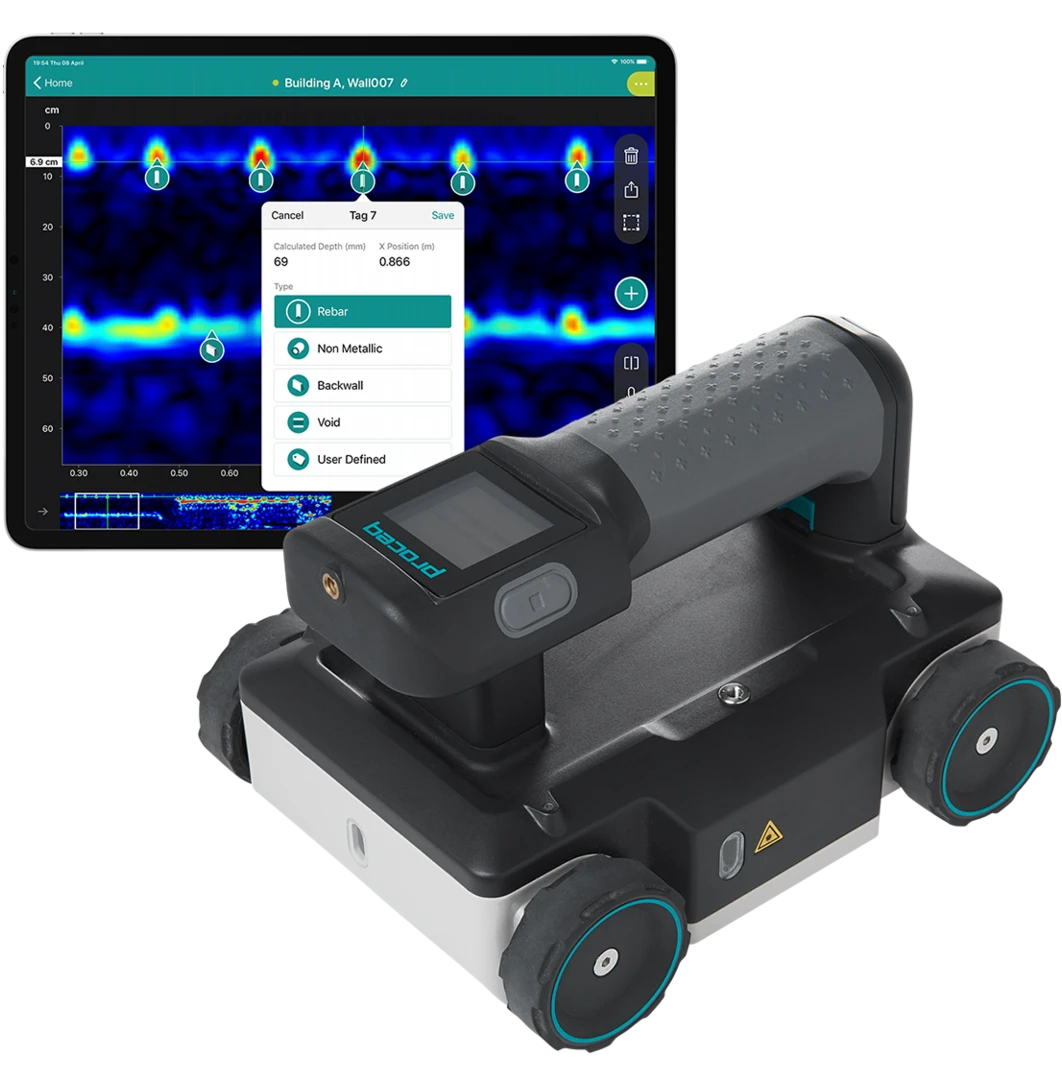
At Structural Repairs, we eliminate the guesswork. We deploy advanced Ground Penetrating Radar (GPR) to provide high-resolution, non-destructive mapping of your concrete assets.
We do not just hand over a scan and walk away; we are an engineering partner. Our technicians use GPR to capture the data, and our structural engineers interpret that data to inform your wider remediation or construction strategy.
- Non-Destructive & Rapid: GPR allows us to map the internal structure of concrete without drilling a single test hole.
- Real-Time Analysis: Our scanners provide immediate radargram data on-site, allowing our technicians to mark the exact locations and depths of hidden elements directly onto the surface.
- Safer Than X-Ray: Unlike traditional concrete radiography, GPR emits zero harmful radiation. It requires no site evacuations, creates no noise, and allows other trades to continue working safely in the immediate vicinity.
- Comprehensive Detection: From structural reinforcement (rebar and post-tension cables) to non-metallic anomalies (subsurface voids, PVC pipes, and areas of delamination), we map the complete subsurface environment.
GPR Technical FAQ
Concrete scanning is a non-intrusive method that uses advanced technology, such as Ground Penetrating Radar (GPR), to identify and assess the elements concealed beneath the surface of concrete structures.
You should use concrete scanning to eliminate assumptions before cutting, coring, or drilling. Hitting embedded objects causes structural damage, safety hazards, and expensive project delays. Scanning provides precise, data-driven mapping, allowing you to execute works safely.
GPR detects both metallic and non-metallic subsurface features. This includes structural reinforcement (rebar grids and post-tension cables), utilities (electrical conduits and PVC plumbing), and physical anomalies (subsurface voids and concrete delamination).
Scanning depth depends on the density and condition of the concrete, as well as the frequency of the antenna used. High-frequency antennas provide incredible detail for shallow depths (typically up to 300mm to 400mm), which covers the vast majority of suspended slabs, walls, and structural columns.
Yes, it is entirely safe. GPR emits extremely low-frequency radio waves—roughly 1% of the power of a standard mobile phone. It creates no dust, emits no radiation, and poses no health risks.